
The Four Chapels of Karnak
There are a lot of places a person can go when they visit Egypt. One of those places is Karnak. When most people think about ancient Karnak, they probably picture columns.
Huge columns.
The Great Hypostyle Hall.
Massive pylons.
Long processional avenues.
Monumental statues.
And that makes sense. Karnak was built to overwhelm you.
But here’s the thing I’ve been thinking about lately:

What happened beyond the spaces designed to impress the public?
Because Karnak was not simply a giant temple where people came to pray.
It was a sacred complex that developed over centuries, with different rulers adding their own monuments, sanctuaries, chapels, halls, inscriptions, and ritual spaces.
Based on my study. The deeper you go into Karnak, the smaller and more intimate the spaces become. And that’s where things get interesting. Because the great public spaces told one story.
The smaller sanctuaries told another. They were sacred spaces of renewal, divine manifestation, resurrection, royal legitimacy, and ritual transformation.
So let’s step away from the giant columns for a moment.
Let’s go inside the chapels.

Karnak Was More Than a Temple
One of the mistakes we make when looking at ancient Egypt is assuming that a temple was simply the ancient equivalent of a modern church. Not at all.
The Egyptian temple was part religious institution, part royal institution, part educational environment, part economic center, and part sacred landscape. And access was not necessarily equal. Everyone at that time did not gain access to those spaces. One had to be qualified and prepared.
There were public areas associated with festivals and procession. But deeper areas of the temple were increasingly restricted.
Priests had purification requirements.
They performed specific rituals.
They cared for divine images.
They prepared offerings.
They recited sacred texts.
They maintained the ritual order of the temple.
And the architecture itself communicated ideas.
Think about that. The walls weren’t just walls. The columns weren’t simply holding up a roof. The inscriptions weren’t decoration. The orientation, imagery, processional routes, sacred objects, and placement of different spaces all contributed to the meaning of the temple.
In other words:
Karnak was something you experienced.
You saw it.
You heard it.
You smelled the incense.
You encountered darkness and light.
You moved through different spaces.
And as you moved deeper into the complex, the experience changed.
That movement matters.
Because Egyptian sacred architecture often deals with transformation.
You enter one state.
You pass through a threshold.
And you emerge into another.
That brings us to the chapels.

1. The White Chapel: Renewal of the King
Let’s start with one of the most beautiful surviving monuments connected with Karnak: the White Chapel of Senusret I.
This chapel dates to the Middle Kingdom, around the early second millennium BCE, and was associated with the king’s jubilee, the Heb-Sed.
This is important. Because Egyptian kingship wasn’t just about sitting on a throne forever.
Kingship had to be renewed.
The Heb-Sed was a royal renewal festival in which the king’s vitality and legitimacy were ritually reaffirmed.
Think about that for a moment.
Even the king needed renewal. In order to be King of Egypt you had to literally be “Fit to rule.”
The White Chapel’s inscriptions include representations of Egypt’s nomes, or administrative districts.
So this little chapel wasn’t merely a pretty building.
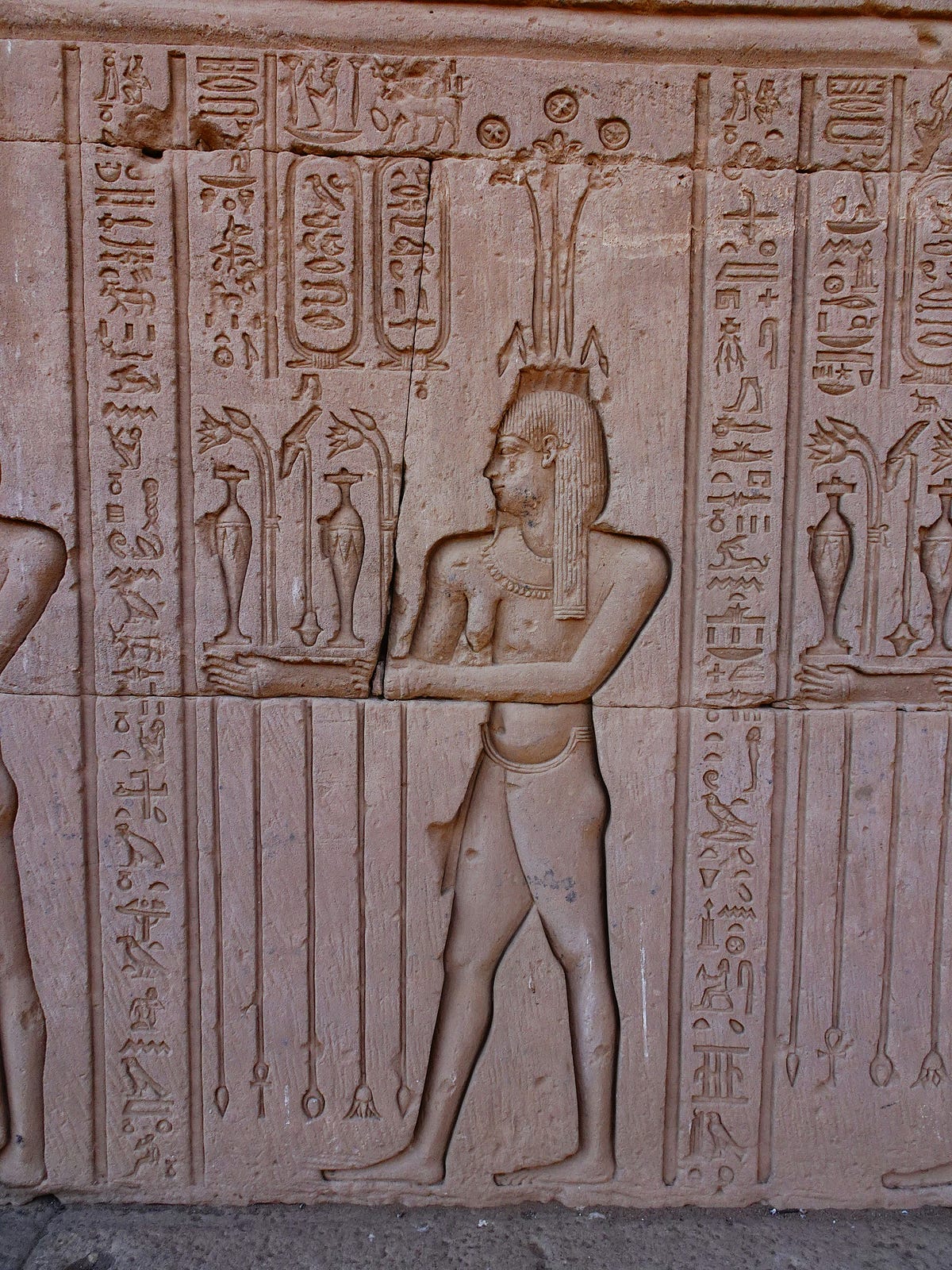
It communicated something much bigger:
The king and the land were connected. Just like when the Ntr Hapi is seen tying the Nile river together. A king had to tie or connect himself to the land, and his people.
The different regions of Egypt appear within the monument, bringing their offerings and participating in the larger order represented by the king.
This is where the concept of Ma’at becomes important.
Ma’at wasn’t “truth” in the modern sense as we know it. It involved order, balance, rightness, justice, and the proper functioning of the cosmos.
The king’s responsibility was to maintain that order.
So the White Chapel becomes a place where kingship is renewed and cosmic order is reaffirmed.
And here’s what I love about it.
The monument is relatively small compared with the enormous structures people associate with Egypt.
But its size doesn’t mean its meaning was small.
In fact, that’s one of the lessons Karnak keeps teaching us.
Sacred architecture doesn’t have to be enormous to carry enormous meaning.

2. The Red Chapel: When Divine Power Becomes Visible
Then we come to Hatshepsut. And yes, our girl Hatshepsut had a chapel at Karnak. The Red Chapel was constructed from red quartzite and black granite and was associated with the sacred bark of Amun.
Now we’re moving into a different dimension of the temple experience. The sacred boat or barque was connected with processions and festivals in which the divine image could travel beyond the sanctuary.
One important festival was the Beautiful Feast of the Valley, when Amun’s sacred bark traveled from Karnak toward the western bank.
The divine presence moved.
It was carried.
It entered the landscape.
And that movement connected temple, king, god, ancestors, and community. Queen Hatshepsut also used the walls of her monuments to communicate her divine legitimacy.
Her famous divine birth narrative presents Amun as the divine father of the future ruler. This was theology and kingship working together.
Hatshepsut was making a statement:
My authority is not merely political. It is divinely sanctioned.
And that brings us to something fascinating about ancient Egyptian kingship.
The king was not simply a politician with a crown.
Kingship itself was embedded within a religious worldview.
That is why royal monuments constantly connect the ruler with the gods, the ancestors, the land, and cosmic order.
The Red Chapel therefore becomes more than a shrine.
It becomes part of a larger conversation about divine manifestation and royal authority.

3. The Osirian Chapels: Entering the Darkness
Now we go somewhere different. The Osirian chapels.
And this is where the symbolism gets particularly powerful. I learned that Osiris represents one of the central Egyptian stories of death, dismemberment, restoration, and renewed life. So when a person enter spaces associated with Osiris, we’re entering a different theological landscape.
We are no longer primarily dealing with royal renewal.
We’re dealing with transformation.
Life.
Death.
Regeneration.
Rebirth.
I think the darkness, and the dark space matters here. Now I don’t mean that we need to turn every dark chamber into some supernatural mystery.
The symbolism itself is enough.
In Egyptian religious thought, darkness could represent the hidden, the unseen, the womb-like condition from which new life emerges.
The sun disappears.
The sun returns.
Osiris dies.
Osiris is restored.
The Nile recedes.
The Nile returns.
The fields become dormant.
The fields become fertile again.
The cycle continues.
That’s the brilliance of Egyptian religious symbolism.
Death is not necessarily the final destination.
It can be a threshold.
A transition.
A transformation.
And the Osirian chapels allowed that theology to become architecture.
The temple could therefore function almost like a map of transformation.
You move from the visible to the hidden.
From light into darkness.
From death toward regeneration.
From one state of being into another.
That’s why I described these spaces in the episode as something like spiritual laboratories.
Not because we need to imagine priests operating some kind of supernatural machine.
But because these spaces were environments in which theological ideas were enacted through ritual. The architecture gave the theology a physical form. (One day we will connect the Temples of Egypt with the body of a man.)

4. The Imperial Chapels: Can a Foreign King Become Legitimate?
Now here’s where Karnak’s history gets really interesting.
Egypt was ruled by many different dynasties.
Some rulers came from outside Egypt.
Persians.
Greeks.
Romans.
And before many of them, we have the Kushite rulers of the Twenty-Fifth Dynasty.
One of the most important was Taharqa.
And this is where Karnak gives us another lesson:
Conquest and legitimacy are not the same thing.
A foreign ruler could conquer territory.
But ruling Egypt involved something deeper.
The ruler had to enter into Egypt’s existing religious and political framework.
Taharqa understood the importance of Amun and Karnak.
The Kushite rulers did not simply arrive and say, “Everything that came before us is gone.”
They participated in and restored aspects of Egypt’s established religious tradition.
Later rulers did similar things in their own ways.
Greek and Roman rulers incorporated Egyptian imagery and religious language into their monuments.
Why?
Because monuments communicate legitimacy.
They tell people:
“I belong here.”
“I am part of the sacred order.”
“I have been accepted into the tradition.”
And that is why Karnak is such an incredible historical record.
You can literally watch different political worlds overlap.
Middle Kingdom.
New Kingdom.
Kushite rule.
Persian influence.
Ptolemaic rule.
Roman rule.
Different rulers.
Different political circumstances.
But the sacred landscape continues.
The temple keeps accumulating layers.
One generation builds.
Another modifies.
Another restores.
Another adds.
Karnak becomes a kind of historical conversation carved into stone.

The Other Chapels: A Divine Network
And then there are the smaller sanctuaries dedicated to other members of the divine world.
Amun.
Mut.
Khonsu.
Ptah.
Sekhmet.
Osiris.
And others.
These weren’t random little buildings scattered around a giant complex.
They participated in ritual networks.
The sacred bark could move through the temple.
Processions connected different spaces.
Priests performed offerings.
Hymns were recited.
Images of the gods were carried.
The temple therefore functioned as a network.
And this is one of the things I think we miss when we only look at individual monuments.
We’re constantly asking:
“What does this building mean?”
But sometimes the better question is:
“What role did this building play within the entire sacred system?”
That’s a very different way of looking at ancient Egypt.
The chapel isn’t isolated.
The statue isn’t isolated.
The inscription isn’t isolated.
The procession isn’t isolated.
Everything participates in a larger structure.

The Four Chapels, Four Ideas
When I step back from all of this, I see four major ideas emerging from these chapels.
The White Chapel — Renewal
The king is ritually renewed and the relationship between kingship, land, and Ma’at is reaffirmed.
The Red Chapel — Manifestation
The divine presence moves from the hidden sanctuary into the visible world through sacred processions and ritual.
The Osirian Chapels — Resurrection
Death becomes a threshold. Darkness becomes the environment for transformation and regeneration.
The Imperial Chapels — Continuity
New rulers enter an ancient sacred system and seek legitimacy by connecting themselves to the established order.
Renewal.
Manifestation.
Resurrection.
Continuity.
I think that’s a powerful framework.
And suddenly Karnak doesn’t look like a collection of old stones anymore.
It looks like a theological landscape.

The Temple Was Designed to Be Experienced
This may be my biggest takeaway.
We often approach ancient Egypt visually.
We look at the photographs.
We admire the columns.
We read the inscriptions.
We study the statues.
But imagine actually moving through these spaces.
Imagine purification before entering sacred areas.
Imagine linen garments.
Bare feet.
Incense.
Offerings.
Sacred images.
Chanting.
Darkness.
Light entering through carefully positioned openings.
The sound of footsteps.
The silence of an enclosed chamber.
The movement of a sacred bark through the complex.
The changing experience as you move from one architectural zone to another.
Now the temple becomes more than something you look at.
It becomes something you enter.
And that’s the difference.
The ancient Egyptians didn’t separate architecture, theology, ritual, kingship, astronomy, symbolism, and landscape the way modern people often do.
They saw relationships.
The temple reflected those relationships.
And Karnak may be one of the greatest surviving examples of that worldview.

Hidden in Plain Sight
Here’s the irony. The “hidden” sanctuaries aren’t necessarily hidden anymore.
We can visit them.
We can photograph them.
Archaeologists can document them.
Scholars can translate their inscriptions.
Tour guides can walk us through them.
But they were once spaces that required preparation and restricted access.
That changes how we should think about them.
The ancient Egyptian temple wasn’t simply designed to reveal everything.
It was also designed to control when, where, and to whom certain things were revealed.
And maybe that’s the real lesson.
Sacred knowledge was not merely information.
It was something connected to preparation, responsibility, ritual, and experience.
So when we stand at Karnak today, we’re looking at more than ruins.
We’re looking at the remains of a civilization that built its theology into stone.
A civilization that understood renewal.
A civilization that contemplated death.
A civilization obsessed with cosmic order.
A civilization that connected kingship to the divine.
And a civilization that understood that sometimes the most important things are not found in the largest room.
Sometimes you have to go deeper.
Past the columns.
Past the spectacle.
Past the monuments.
Into the smaller chambers.
Into the darkness.
Because sometimes the place where the light disappears is the very place where the ancient Egyptians believed transformation began.
Peace and blessings, Ujumbe family.
Check out these books and gifts on Amazon!
Thanks for reading! As an Amazon Associate, I get a small commission for each purchase you make after you click on my link and you shop, but it doesn’t cost you anything extra. Please use my links below!
In this landmark volume, one of the world's most renowned Egyptologists tells the epic story of this great…amzn.to
The Temple of Karnak: The Majestic Architecture of Ancient Kemet, published (2023) by SuMon Publishers is an updated…amzn.to
DECODING THE SYMBOLS: A Beginner's Guide to Kemetic Spiritual Science - Kindle edition by Cameron Sr., Marques D…a.co
Interested in exploring the depths of history, education, or religion through engaging articles? I’d love to contribute my expertise as a freelance writer.
Feel free to reach out at kingcamujumbe@gmail.com for collaborations or inquiries. Let’s create something impactful together!


